I have never hidden my feelings about running, come on ask me, I'll tell ya! From a physical stress standpoint, I think it is one of the hardest forms of exercise you can put your body through. Every stride involves repeatedly absorbing and producing force, usually thousands of times per workout, and unlike strength training there isn't much of a break between reps. That doesn't make running bad for you. Running can be a fantastic form of cardio, and like most forms of training, an appropriate amount can produce some pretty significant health benefits. The important part of that sentence, as we are about to find out, is "an appropriate amount."
Now imagine taking running to its absolute extreme. Enter the ultramarathon. Technically speaking, an ultramarathon is any run longer than the traditional marathon distance of 42.2 km, although some races will cover 50 km, 100 km, 100 miles or even multi-day distances. Apparently, at some point running a regular marathon became too easy, so humans naturally decided the solution was to just keep going.
A new case study I read recently used an absolutely brutal running challenge to show us exactly what happens when endurance volume gets pushed about as far as humanly possible. Researchers followed a 49 year old experienced ultra-endurance athlete attempting to run 30,300 km. Over 444 days, he averaged roughly 68 km of running per day, with many days around or above 70 km. For some perspective, that is considerably more than a marathon every single day for about 15 months. If your knees started hurting just reading that sentence, you aren't alone.
As I'm sure you probably could have guessed, his body wasn't completely thrilled about it either. Our lone soldier in this study experienced significant lower leg soreness and developed painful shin splints during the challenge, along with several other muscle and skeletal changes. What I found interesting is that some of that discomfort eventually improved even though he continued running, which is a pretty strong testament of the body's ability to adapt. But just because something stops hurting doesn't necessarily mean everything happening underneath the hood is positive.
By the end of the challenge, his body mass had dropped by approximately 7lbs. Most of that loss was fat, which isn't exactly shocking when you're spending roughly nine hours a day running. What caught my attention the most was what happened to his muscle. Post-run lab measurements showed reduced thigh muscle thickness, while maximal strength dropped by roughly 25%. His vertical jump height and power decreased by about 50%, and his ability to rapidly absorb and reproduce force took an even bigger hit. In other words, he became really good at doing one thing for a very, very, very long time, but significantly worse at being twitchy and strong.
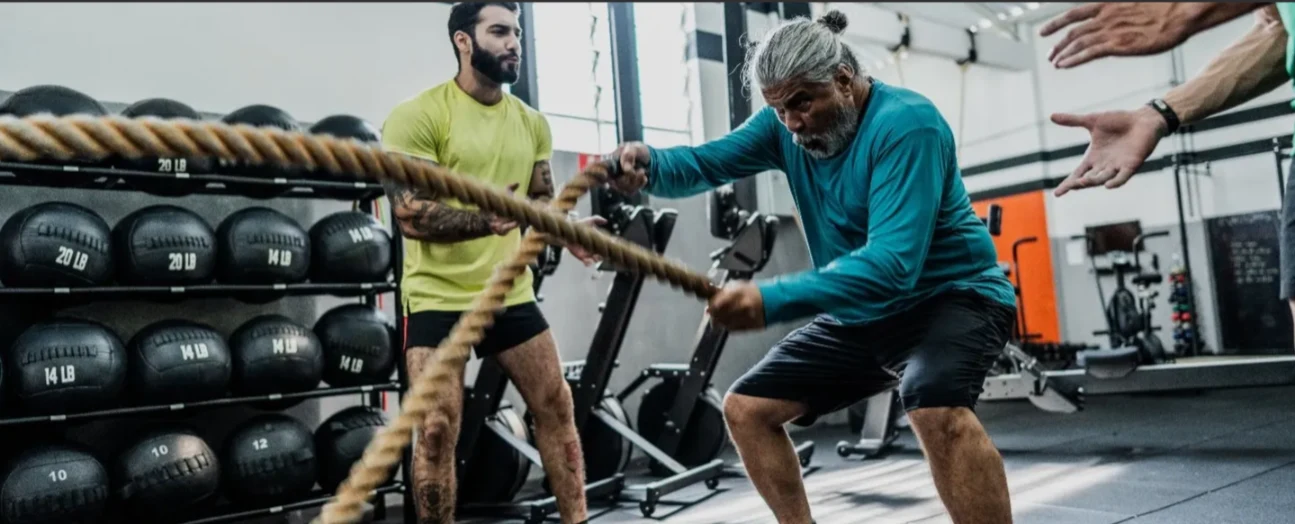
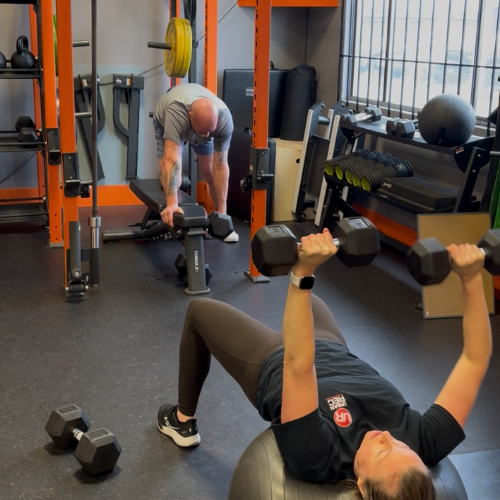
This is important for all of us to understand because losing weight and improving fitness aren't automatically the same thing. It's something I reinforce in our Small Group Training and Personal Training programs all the time, and especially when people try one of our InBody scans. Cardio is useful, but if the only tool in your toolbox is burning more calories, you may be sacrificing the tissue that we actually want to keep. Strength training gives the body a very different signal, basically that all this muscle you have is useful, so let's hang onto it.
The researchers also found that the athlete's muscles had essentially transformed themselves for the task. After the challenge, nearly 100% of the muscle fibres sampled from his quad showed slow-twitch characteristics. Slow-twitch fibres are great for endurance, which makes perfect sense when you're asking your legs to run for the whole day. The trade-off is that they aren't particularly good at producing force or power. His body became specialized for endurance, but specialization always comes with a cost.
What makes the study even more interesting (to me at least) is that the usual hormonal explanation doesn't tell the entire story. Testosterone remained relatively stable, while IGF-1 another anabolic signal involved in muscle growth and repair, decreased by roughly 30%. Myostatin, which essentially acts as one of the body's brakes on muscle growth, also increased. So while the hormonal environment became somewhat less favourable for maintaining muscle, the endocrine system didn't completely fall apart.
This is where cellular signalling becomes important. One pathway often discussed with very high volumes of endurance training is AMPK. You don't need to remember the acronym, but you can think of AMPK as one of the body's energy sensors. When energy demand becomes extremely high, AMPK helps shift resources toward producing energy and surviving the immediate workload rather than building new tissue. When that signal is repeatedly elevated, it can interfere with some of the pathways responsible for muscle growth. Essentially, if your body believes its full-time job is running 70 km tomorrow and the next day, while building bigger, stronger muscle isn't particularly high on the priority list.
This concept is one of the reasons we don't just have our hockey training athletes spend their entire summer running laps. Hockey requires conditioning, shocker, but it also requires strength, speed, power and the ability to repeatedly produce force. The same logic applies to our Youth Strength Training athletes. Developing cardiovascular fitness is valuable, but so is building strength, coordination, power and muscle during the years when those physical qualities are developing. Training should create a well-rounded athlete, not simply someone who is really good at being tired.
Perhaps the craziest finding was how long some of these changes lasted. Strength measures largely recovered within about 10 months, but some measures of power and reactive strength were still below baseline 17 months later. At the cellular level, mitochondrial and other muscle-related markers also continued changing throughout the 17-month recovery period. So after running for 444 days, apparently your body doesn't simply wake up the following Monday and decide everything is back to normal.
Of course, there are some enormous limitations with the study. This was a case study involving exactly one person, and that person was a 49 year old highly experienced ultra-endurance runner who was already running approximately 120 km per week before deciding that apparently it wasn't enough. We can't take the results from one extremely unique athlete and assume the same changes would occur in everyone. Then again, I imagine the researchers didn't exactly have a lineup of volunteers eager to run 30,000 km so they could improve the sample size. Again... shocker.
The point isn't that running is bad, and it definitely isn't that you should stop doing cardio. The bigger lesson is something we see repeatedly in exercise science, more is not always better. Training tends to follow something resembling a bell curve. Going from doing nothing to exercising regularly produces enormous benefits. Adding more training can produce additional improvements, but eventually you reach a point of diminishing returns. Push far enough beyond that point and the stress you're applying can begin to outweigh the body's ability to positively adapt.
This is particularly important as we age because maintaining muscle mass, strength and physical function becomes increasingly important. Whether we're helping someone get stronger in Small Group Training, rebuilding capacity through Active Rehab after an injury, or working one-on-one with someone who simply wants to stay capable as they get older, the goal isn't to see how much exercise we can survive. The goal is to apply enough stress to create the adaptation we actually want.
Running 30,300 km is obviously an absurd example, but that's also what makes this study so interesting. It essentially took endurance training, turned the volume knob until it broke off, and allowed researchers to see where the human body decided to compromise. The athlete became exceptionally adapted to prolonged running, but those adaptations came alongside reduced muscle size, strength, power and changes that in some cases persisted for more than a year.
You've got the info, now it's time to take AIM!




.webp)

















.webp)






.png)







.webp)