
If I had a dollar for every time someone told me their fitness goal was to do a pull-up, I'd probably have enough money to buy one of those fancy wall-mounted pull-up rigs that nobody actually uses. It's one of the most common goals people have when they start training, and I completely understand why. There's something satisfying about being able to pull your entire body up over a bar under your own strength.
Realistically though, if we're talking about survival, you probably only need to be able to do one. If you're hanging off the edge of a cliff, nobody is asking you to bang out a set of twelve. Yet somehow pull-ups have become one of the gold standards of fitness, showing up everywhere from military testing to hockey combines to your local gym.
There are some good reasons for that. Pull-ups require almost no equipment. You need a bar and your own body weight, making them simple, accessible, and inexpensive. They also train one of the major movement patterns that we emphasize at AIM Athletic, the vertical pull. Whether you're training in our Small Group Training program, Personal Training, Youth Strength Training, Active Rehab, or one of our hockey training groups, developing upper-body pulling strength is important. That said, I think pull-ups get a little more credit than they deserve. Not because they're a bad exercise, they're not, but because we often misunderstand what they're actually telling us.
The biggest limitation is that pull-ups are heavily influenced by your strength-to-body-mass ratio. Imagine you begin a training program weighing 190 pounds and can perform five pull-ups. A few months later you've lost 20 pounds and can now perform ten. Did your pulling strength improve? Quite possibly. But you also removed 20 pounds from the exercise. It's a little like taking weight off the bar and then celebrating your new personal best.
This is one of the challenges with using bodyweight exercises as objective strength tests. Unlike a lat pulldown, where the resistance stays exactly the same every time you test it, the resistance in a pull-up changes whenever your body weight changes. To truly compare your performance over time, you'd have to normalize your body weight before every test. That's easier said than done when your weight can fluctuate a few pounds from hydration, food intake, or yesterday's pizza. None of this makes pull-ups a bad exercise, it simply means they aren't quite as clean of a strength measurement as many people think.
They're also not necessarily my first choice if the goal is purely building muscle. If someone can only perform two or three pull-ups before they start swinging around like they're auditioning for Cirque du Soleil, it's difficult to accumulate enough quality training volume. In those cases, an assisted pull-up or lat pulldown often gives us a better muscle-building stimulus because we can control the resistance and perform more quality repetitions.
So why are pull-ups still everywhere? Mostly because they're incredibly practical. Whether it's a hockey combine, military fitness test, or the old Presidential Physical Fitness Test, you can test dozens of people in a short period of time with nothing more than a pull-up bar. They're also hard, and that's part of their appeal. Moving your entire body through space requires a significant amount of relative upper-body strength, and earning your first pull-up is absolutely something to be proud of.
The next question, of course, is how do you actually get better at them? The traditional advice is to simply do more pull-ups. That can absolutely work for someone who already has a solid foundation. But like I said earlier, if your maximum is only two or three repetitions, every rep is performed at nearly your limit. You fatigue quickly, your technique falls apart, and you've accumulated very little quality practice before the set is over.
That's because pull-ups are a skill just as much as they are a strength exercise. Every repetition teaches your nervous system how to coordinate multiple muscles into one efficient movement. Your brain has to learn when to recruit your lats, stabilize your shoulder blades, brace your core, and coordinate everything from your grip to your trunk. Just like learning a slapshot, a golf swing, or riding a bike, becoming more efficient comes from repeated quality practice. That's one reason beginners often see pull-up improvements faster than they build muscle. Their nervous system is simply getting better at solving the movement.
This is also why the popular "grease the groove" approach doesn't work equally well for everyone. If you can already perform ten pull-ups, doing a few throughout the day lets you accumulate lots of quality repetitions without much fatigue. If your maximum is only two, you've accumulated very little practice before you're exhausted. That's a lot of fatigue for not much learning.
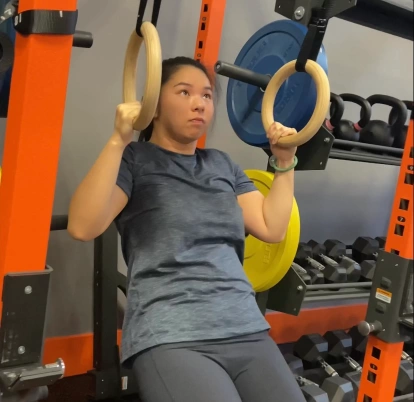
At AIM Athletic, we'd rather increase the amount of quality practice than simply make people struggle through failed repetitions. One of the easiest ways to do that is with a long elastic band and assisted pull ups. Most people think the band is just making the exercise easier, but it's actually giving you far more opportunities to practice the movement with good technique. Someone who can only perform two strict pull-ups might suddenly be able to perform eight or ten quality repetitions. That's four or five times more practice while still providing enough resistance to build strength. We also tend to train vertical pulling two or three times per week when improving pull-ups is a goal because, like any skill, consistency matters.
I'm also a big fan of slow eccentrics and isometric holds. Your muscles are actually stronger during the lowering phase of a movement than they are while lifting, so someone who can't yet pull themselves all the way up can often control themselves on the way down. Jump to the top, lower yourself slowly, and you've still trained the muscles through one of their strongest contractions. Holding different positions throughout the movement is another great way to build strength while reinforcing proper body position and control.
For our more advanced hockey athletes, I've recently been using what I call "Devil Sets". This complex includes six weighted pull-ups immediately into six bodyweight pull-ups, followed by six assisted pull-ups. By progressively reducing the resistance as fatigue builds, we're able to accumulate far more quality vertical pulling work than stopping when the weighted reps become difficult. It's definitely not something I'd prescribe to someone chasing their first pull-up, but for advanced athletes it's an incredibly effective progression.
The bigger lesson here is that pull-ups are a great exercise, but they're still just one exercise. They aren't a magical measure of strength, they aren't mandatory for building a strong back, and they certainly aren't the only way to develop impressive upper-body pulling strength. If your goal is to perform your first pull-up, train smarter rather than simply trying harder. Focus on quality repetitions, practice the movement frequently, build strength with assistance when needed, and let your nervous system learn the skill.
You've got the info, now it's time to take AIM!

.webp)




.webp)

.png)




.webp)