
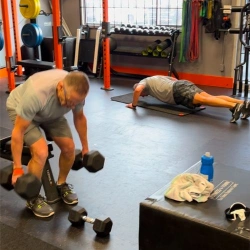
I had a great question from a member this week, that I thought would make for a great post. They wanted to add some workouts at home but only had a pair of 10lb dumbbells. Since they lift considerably more at AIM, they wanted to know if it was even worthwhile? Once you’re used to heavier weights, those little dumbbells can feel like bringing a spoon to a construction site. But yes, they can still be useful. We just need to think about how we use them.
First, my general feeling about movement is that some is usually better than none. That doesn’t discount rest, especially if you’re working hard in small group or personal training two to four times a week. From that perspective, sometimes a walk is a better addition than another leg workout. However, improving our health and body composition also means considering what happens outside the gym. Lets say you're on our Performance Plan, four hours of training is only about 2.4% of a 168-hour week. The other 164 hours don’t stop counting because you did Bulgarian split squats on Tuesday.
We’ve discussed NEAT before, which is non-exercise activity thermogenesis, or the energy we use moving outside deliberate exercise. Walking the dog, cleaning, gardening and taking the stairs all contribute. You don’t need to turn laundry into a competitive sport, but everyday movement adds up. A home workout can contribute too, provided it complements your training and leaves enough room for recovery.
Traditionally, we are taught that heavy weights are needed to build muscle while light weights and high reps are for fat loss or “toning.” Convenient categories, but your muscles haven’t read that textbook. Muscle can grow across a broad range of loads when the sets are challenging enough. Heavier weights are particularly useful for developing maximal strength, but for muscle growth, the number on the dumbbell isn’t the whole story. With lighter weights, your proximity to muscular failure becomes especially important.
Failure means you can’t complete another repetition with good technique. It doesn’t mean you’re bored or suddenly remembered something urgent in the kitchen. You don’t need to fail every set, but stopping at 15 reps when you could do another 30 probably isn’t much of a muscle-building challenge. With 10s, some exercises might require a lot of repetitions, which sounds fairly awful to me personally, but it can work. Extremely light loads also have limitations, doing reps forever isn’t automatically equivalent to heavier training from a muscle fiber perspective.
Think about car mechanics. If you asked me which profession I associate with impressive forearms, they’d be high on the list. They spend their days gripping and cranking wrenches rather than organising everything into three sets of eight. That isn’t scientific proof, and a stubborn bolt can demand considerable force, but it illustrates why repetitive work isn’t automatically useless for building muscle. Your forearms don’t know whether you’re holding a dumbbell or trying to remove a rusted nut.
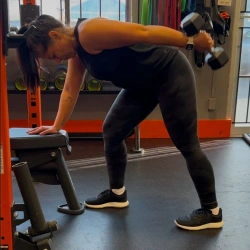
Fortunately, adding weight isn’t our only option. We can adjust reps, speed, exercise variations and leverage. Ten pounds might barely register in a squat, but can be surprisingly rude in a lateral raise. The challenge depends on what you ask your muscles to do with it.
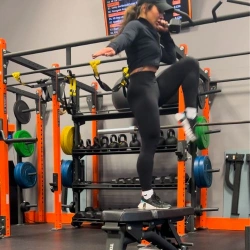
Consider speed. From a physics standpoint, force equals mass multiplied by acceleration. We can change force demands by accelerating faster, rather than just adding mass. Switching a squat to a squat jump means producing force quickly to leave the ground, then absorbing force when you land. Your muscles work concentrically as they shorten during take-off and eccentrically as they lengthen to control the landing. That creates a different challenge without needing heavier dumbbells.
That doesn’t mean everyone should start doing weighted jumping lunges beside their coffee table. Your knees and downstairs neighbours may have opinions. Jumps develop power and need appropriate progressions, something we work on in youth training. Keep them controlled and stop before fatigue wrecks your landings. For a muscle-focused home workout, slowing the lowering portion of an exercise is another way to make light weights more demanding without adding impact.
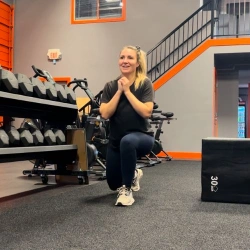
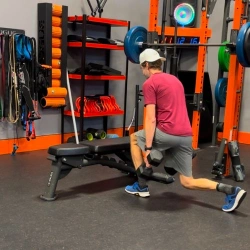
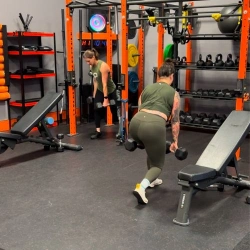
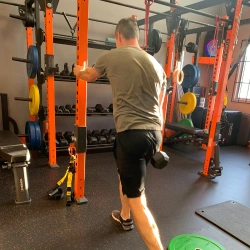
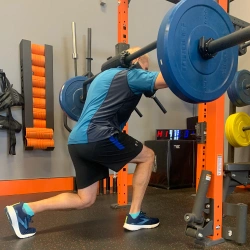
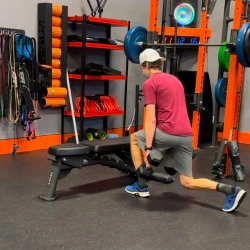
Next, change how the work is distributed across your body. Squats with 10s too easy? Try split squats. Already comfortable there? A Bulgarian split squat or supported skater squat directs more of the work through one leg, making your body weight a bigger part of the resistance. More complicated isn’t automatically better, though. If balance gives out before your legs do, hold a support. We’re training muscles, not auditioning for the Royal Ballet.
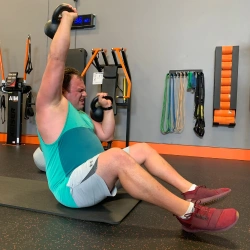
Leverage matters too. In a chest fly, the dumbbell sits farther from your shoulder than in a chest press, increasing torque around the joint. The same weight becomes harder for your chest to control. That also increases the demand on the shoulder, so keep the movement controlled and use a comfortable range. Pauses and isometric holds offer another option, you can pause near the bottom of a squat or hold a split-squat position. More time producing tension can make a light set harder, although time under tension isn’t a magic muscle-growth formula.
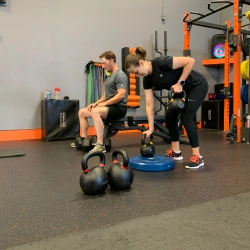
These are the same adjustments we make in small group and personal training to suit the person and their goals. In youth training, we might progress control or power before adding weight. In active rehab, a supported exercise, slower lowering phase or isometric hold can help build capacity within someone’s current tolerance. Every set doesn’t need to end in failure to serve a purpose.
So yes, those 10lb dumbbells are worthwhile. They won’t replace every benefit of heavier training, but the right variations can still challenge your muscles and add useful activity to your week. Make the reps count, recover for your sessions at AIM, and stop assuming the little dumbbells are a waste of time.
You've got the info, now it's time to take AIM!

.webp)




.webp)

.png)




.webp)