
Go to any gym and it's pretty common to see someone using mini bands on their knees before their workout. Sometimes it's because their program calls for it. Sometimes it's because they saw it on Instagram. Sometimes it's because a physiotherapist, chiropractor, trainer, or YouTube fitness guru told them they have "sleepy glutes" that need to be activated before training. The idea sounds reasonable. If a muscle isn't working properly, wake it up before training and everything will magically improve. The problem with this idea is that the human body is rarely that simple.
Before we can talk about activation, we should probably define what it actually means. Pre-workout activation is simply the process of increasing neural drive to a muscle before a movement. In practical terms, you're trying to improve a muscle's ability to contribute to an exercise by getting the nervous system to pay a little more attention to it. This can be useful when preparing for a workout, especially if a particular muscle group has been underutilized due to injury, pain, or poor movement habits.
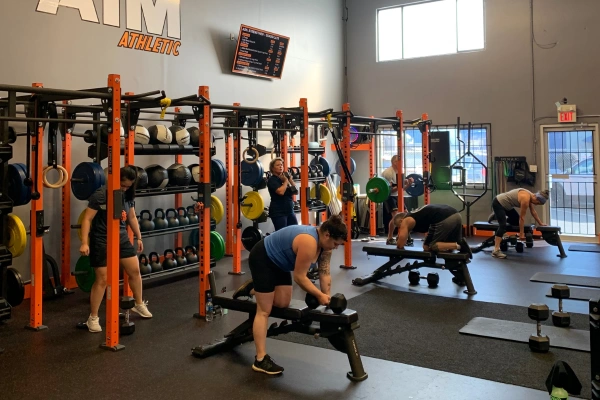
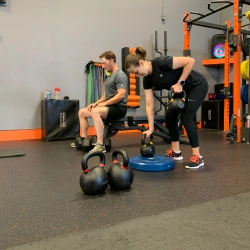
Mini band walks are one of the most popular activation exercises around. You'll see people shuffling sideways across gym floors everywhere, we even do it at AIM Athletic sometimes before our small group and hockey training sessions. The exercise creates a serious burn through the outside of the hips, which makes people feel like something important is happening. The lateral glute muscles, particularly glute medius and glute minimus, are working hard. The problem is that these muscles function primarily as stabilizers rather than major movers. Their main job is to control pelvic and hip position while you move, not necessarily to produce large amounts of movement themselves.
This raises an interesting question. If you spend several minutes performing band walks before squats, lunges, step ups, or deadlifts, are you activating those muscles or are you simply pre-fatiguing them? The answer is probably a little bit of both.
This is one of the reasons I tend to be cautious when people talk about glute activation. We have to remember that muscles do not know what exercise you are performing. They only know tension, stretch, force production, and neural input. If you work a muscle hard enough before your workout, there comes a point where you're no longer preparing it for exercise. You're actually reducing its ability to contribute during the exercises that follow.
The concept of "glute amnesia" has become especially popular over the past decade. The theory is that prolonged sitting causes the glutes to essentially forget how to work. While sitting all day can certainly influence posture and movement patterns, the idea that your glutes have somehow fallen asleep and need to be awakened every day is probably an oversimplification. In reality, your glutes are working all the time. If they truly stopped functioning, standing up, walking, climbing stairs, and balancing on one leg would be impossible. Most people don't have sleepy glutes. What they often have is a positioning problem.
To understand why, we need to talk briefly about how muscles actually generate force. At the microscopic level, muscles contract through the interaction of two proteins called actin and myosin. These structures slide past one another, pulling toward the Z-discs within the muscle fiber and shortening the muscle. The amount of force a muscle can produce depends heavily on its length when this interaction occurs.
Muscles generally have their greatest force-producing potential near their neutral resting position. As they become excessively shortened or excessively lengthened, force production decreases. Think of it like trying to win a tug-of-war while either standing too close to the rope or stretched too far away from it. Neither position is ideal. This is where joint position becomes incredibly important because (if you've been following these posts, you'd know) joint position dictates muscle function.
If the pelvis and hips are positioned poorly, certain muscles may spend much of their time in shortened positions while their opposing muscles remain lengthened. An anterior pelvic tilt is one example. A sway-back posture is another, although less common. In these situations, the glutes may not be weak because they're asleep. They may simply be operating from a mechanical disadvantage and it's a lot harder for a muscle to produce force when its length-tension relationship isn't ideal.
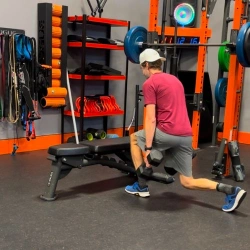
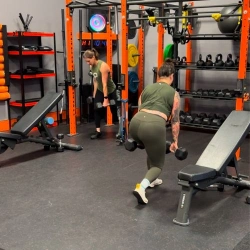
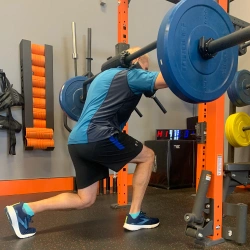
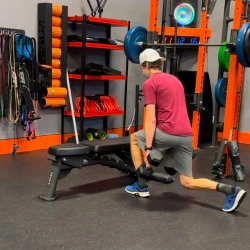
This is one of the reasons why, in our Small Group Personal Training, Personal Training, and Active Rehabilitation programs at AIM Athletic, we spend so much time looking at movement quality and joint position rather than simply trying to make muscles burn. Sometimes the answer isn't another activation drill. Sometimes the answer is improving the position from which the muscle is expected to work. In fact some EMG studies have shown greater glute activation during unilateral exercise like split squats than mini band walking.
That doesn't mean band walks are useless. I actually like band walks for many people. They create a serious local burn, they build tolerance and endurance in the external hip rotators, and they can be a useful tool for improving hip stability over time. They also give people a better awareness of what the lateral hip muscles feel like when they're working. The important thing is understanding why you're doing them.
If you're using them as a conditioning exercise for the lateral hip muscles, great. If you're using them to build capacity and tolerance, great. If you're using them because you think your glutes are asleep and forgot how to function, the explanation is probably a little more complicated. As with most things in exercise science, the answer isn't usually activation versus no activation. The answer is understanding the goal of the exercise and applying the right tool at the right time (make the main thing, be the main thing).
You've got the info, now it's time to take AIM!

.webp)





.webp)

.png)




.webp)