
Tackling another member question this week because it still comes up a lot, “How much do I need to work out?” Sometimes it comes with "helpful" context, like, “I want to lose 40 pounds in three weeks.” Right, and I would like to retire by next Thursday. If you've known me long enough, we both know that probably isn't going to happen. The answer depends on your goals, your starting point, and what you can realistically stick with.
Since AIM is a strength training gym, let’s approach this from the perspective of building muscle and strength. We know that resistance training can help reduce body fat and preserve muscle during weight loss, but muscle does not automatically make fat disappear. Food intake and overall activity still matter. Your biceps unfortunately are not exempt from energy balance.
When it comes to building muscle, how much training you need depends heavily on how much you have already done. Beginners can make meaningful progress with much less work than experienced lifters. Your body is encountering a new challenge, so a relatively modest amount of well planned training can give it a strong reason to adapt.
These are the famous “newbie gains,” and they are about the closest thing the gym offers to a welcome bonus. Early strength improvements come partly from your nervous system learning to recruit muscles and coordinate movements more effectively. You get better at bracing, controlling the weight, and producing force. Muscle growth contributes too, but adding weight to your squat does not mean every improvement came from bigger legs.
This is why beginners do not need to dive into six workouts a week. Technique takes practice, and muscles, tendons, and joints need time to adjust to the gym. Being so sore that you lower yourself onto the toilet like you are defusing a bomb is not a requirement for progress. You need enough challenge to stimulate adaptation and enough recovery to benefit from it.
Eventually, though, the same workout becomes less demanding. A weight that once made ten repetitions difficult might become comfortable for fifteen. Your body has accommodated to the demand. This is where progressive overload (I said the thing again) comes in, gradually increasing the challenge as your capacity improves. That can mean more weight, more repetitions, additional sets, or more frequent training to spread that work across the week.
You do not need to constantly change exercises to “confuse” your muscles. They most likely don't need a M. Night twist. They need a challenge that matches your abilities. Adding more work can help, but only if you can perform it well and recover from it. More fatigue does not automatically mean more progress.
Another thing I've mentioned before, is that the main stimulus for muscle growth is mechanical tension, in other words, the force muscle fibres experience while working against resistance. That tension helps trigger the body to build new muscle proteins, allowing those fibres to grow over time. Exercise selection and technique obviously influence where that demand goes. Squats train your quadriceps and glutes, but your hamstrings, shoulders, and back still need appropriate work. Being present in the room does not count as a training stimulus unfortunately.
My blanket recommendation for beginners is to train every major muscle group at least once a week. That is a starting point, not a ceiling. One full-body session can introduce the routine, while two manageable sessions offer more practice. Initially, consistency, controlled technique, and learning how hard to work matter more than cramming in every exercise available.
For intermediate lifters wanting to build more muscle, training each major muscle group twice a week is a practical target. It spreads the workload out and helps maintain quality. If all your leg training happens in one marathon session, eventually your concentration slips and the last few sets can start looking like interpretive dance. Dividing that work between sessions can make it more productive, and you'll ultimately get more out of your workout.
Advanced lifters may benefit from training certain muscle groups two or three times weekly, particularly areas they want to prioritise. They may also need more weekly volume to keep progressing. However, frequency itself is not magic when total weekly volume is matched, research often finds similar muscle growth across different frequencies. More than anything extra sessions help organise quality work they are not automatically required because you have been lifting for years.
This distinction matters, three gym visits do not necessarily mean you train every muscle three times. A chest day, back day, and leg day may only train each area once, while a planned full-body routine like we do in most of our workouts at AIM, provides repeated exposure. Two or three gym days can remain effective as you advance. The problem is doing the same weights, repetitions, and workload indefinitely while expecting different results. Your program needs to progress, even if your schedule stays the same.
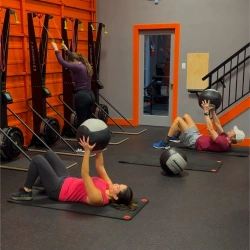
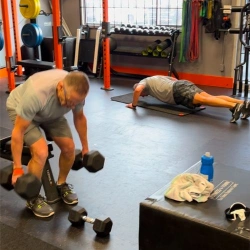
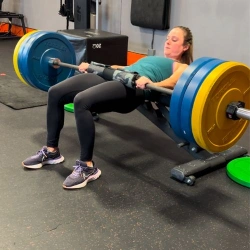
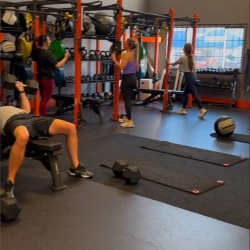
At AIM, our small group programming is laid out so members on our Core 3x/week program train every major muscle group twice across the week. In personal training, we can tailor that workload to someone’s experience, schedule, and priorities even further. Active rehabilitation follows the same principle of gradual progression, with exercise adjusted to current function and symptom tolerance. For youth athletes, we focus on movement skills and strength while accounting for practices, games, and recovery.
Ultimately, start with an amount you can repeat consistently, cover the muscles and movements you want to improve, and increase the challenge as your ability grows. Beginners do not need an advanced lifter’s workload, and experienced lifters cannot expect beginner gains forever. Your program should grow with you. That is a better plan than trying to squeeze three years of progress into the three weeks before your holiday.
You've got the info, now it's time to take AIM!


.webp)





.webp)


.png)




.webp)